
08.10.26
Mondo participated in the international ANGEL conference
Why should every country prioritise Global Education in its schools?
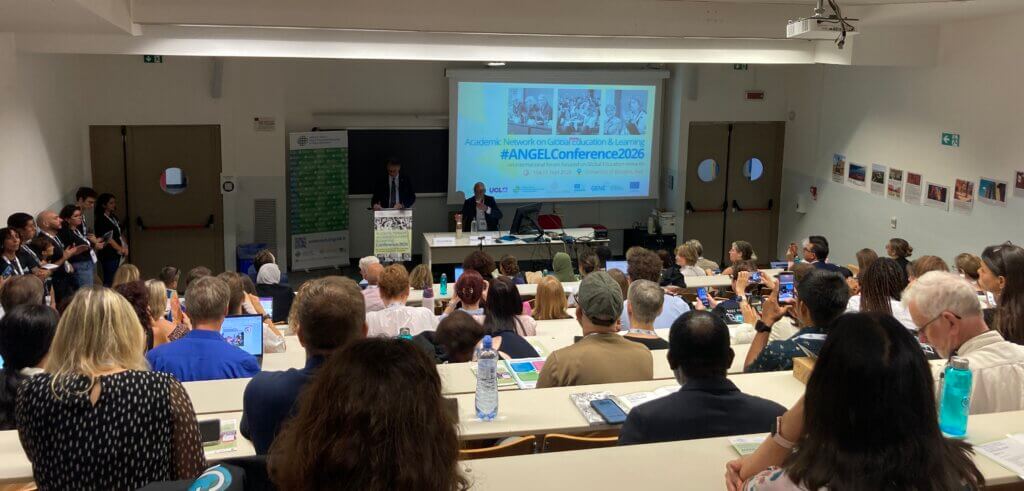
In September we participated in the ANGEL (Academic Network on Global Education & Learning) conference in Bologna, where the world’s leading Global Education scientists, practitioners and policy makers focused on this question. #ANGELConference2026
Here are 3 things from the conference that our Meelis Niine and Mari Jõgiste highlight:
- The conference discussed what kind of global education we need at a time when societies are affected by wars, the climate crisis, inequality and political polarisation. One recurring idea was the need to combine critical understanding of the world with agency and hope. Understanding the causes of complex problems and the power relations behind them is important, but education must also help young people see the opportunities to contribute to change themselves, together with others.
- The question of justice emerged in several conference themes. In the case of the climate crisis, it was emphasised that it cannot be treated solely as an environmental problem. It is also important to ask who bears historical responsibility, who is most vulnerable to the impacts of climate change, and whose knowledge and experiences come to the fore in education. Likewise, discussions on peace education highlighted that peace does not mean only the absence of conflict, but is closely tied to justice, human rights, and people’s ability to have a say and take action in society.
- The conference also paid a lot of attention to how to move from individual projects toward more systemic global education. Global education cannot depend only on active teachers; it needs support from school leadership, cooperation within the school, and links to education policy and teacher training. There was also discussion on how to assess the impact of global education in a way that measures not only the number of participants or their knowledge, but also changes in understanding, relationships and capacity to act.
Mari Jõgiste from our team also took the stage with Anu Railasto-Moran from the Finnish RKI to speak about Critical Global Education: Navigating Tensions, Reflexivity, and Transformation. Drawing on the experiences of teachers from Estonia, Finland, Portugal and Romania, one of the conclusions was that good methods alone are not enough for critical global education. Teachers need time, substantive knowledge, support from school leadership, and the opportunity to examine their own assumptions and worldview.
For Mondo, the conference above all confirmed the need to further develop a whole-school approach, to support teachers in addressing complex global topics, and to link critical thinking more strongly with young people’s agency. These insights will carry over into Mondo’s teacher training and the development of learning materials.
Meelis Niine’s participation in the ANGEL Conference 2026 was supported by the Estonian Foundation for Civil Society (KÜSK).